
Michigan Corrections Releases for Roscommon Cases
The Michigan Department of Corrections operates the state prison, parole, and felony-probation system. It is not Roscommon County Jail. A felony case from Roscommon can lead to commitment to MDOC, but the assigned prison is determined statewide. Research found no state prison inside Roscommon County. An official in-reach assignment names Saginaw Correctional Facility as serving Region 3, including Roscommon, for one program function, but that does not prove that a particular person is held there.
A release from an MDOC prison may lead to parole in the community under state supervision. OTIS Current Status “Parole,” paired with Date Paroled, confirms departure from prison onto parole more strongly than a future date or Board decision. A person can also reach the maximum discharge point without parole. After supervision ends, OTIS may show Discharged with a discharge date and reason.
These milestones must stay separate. Leaving Roscommon County Jail for MDOC is a transfer into state custody, not release from corrections. Leaving an MDOC prison on parole is release from prison but not discharge from supervision. Discharged means the displayed MDOC order ended, subject to the scope and display limits of that record.
Confirm a Michigan Corrections Release
OTIS covers prisoners, parolees, probationers, interstate-compact cases, escapees, absconders, and people discharged from MDOC within the last three years. It expressly excludes county jail and city lockup prisoners and people sentenced only to jail. Use the sentencing source before searching so a county-only case is not mistaken for a missing state profile.
- Open the Michigan OTIS offender search and accept its terms.
- Search with the MDOC number when known, or enter the committed last name. A wildcard is available after at least three initial surname characters.
- Compare the MDOC number, date of birth, aliases, physical identifiers, sentencing county, and court file.
- Read Current Status, Date Paroled, Assigned Location, supervision dates, and sentence blocks together.
- For a prisoner, treat Earliest Release Date as the Board's first jurisdiction point, not a scheduled departure.
- For a former prisoner, confirm Parole or Discharged status and the associated date, then seek the agency record if the outcome needs more detail.
A no-result conclusion must remain narrow. OTIS public display ends three years after discharge and can change after an eligible set-aside. Spelling, committed names, aliases, and jurisdiction also affect results. The Roscommon County released inmate search covers the county jail, court, and state paths when the custodian is uncertain.
The official OTIS search page shows the statewide release lookup used for a Roscommon County commitment.
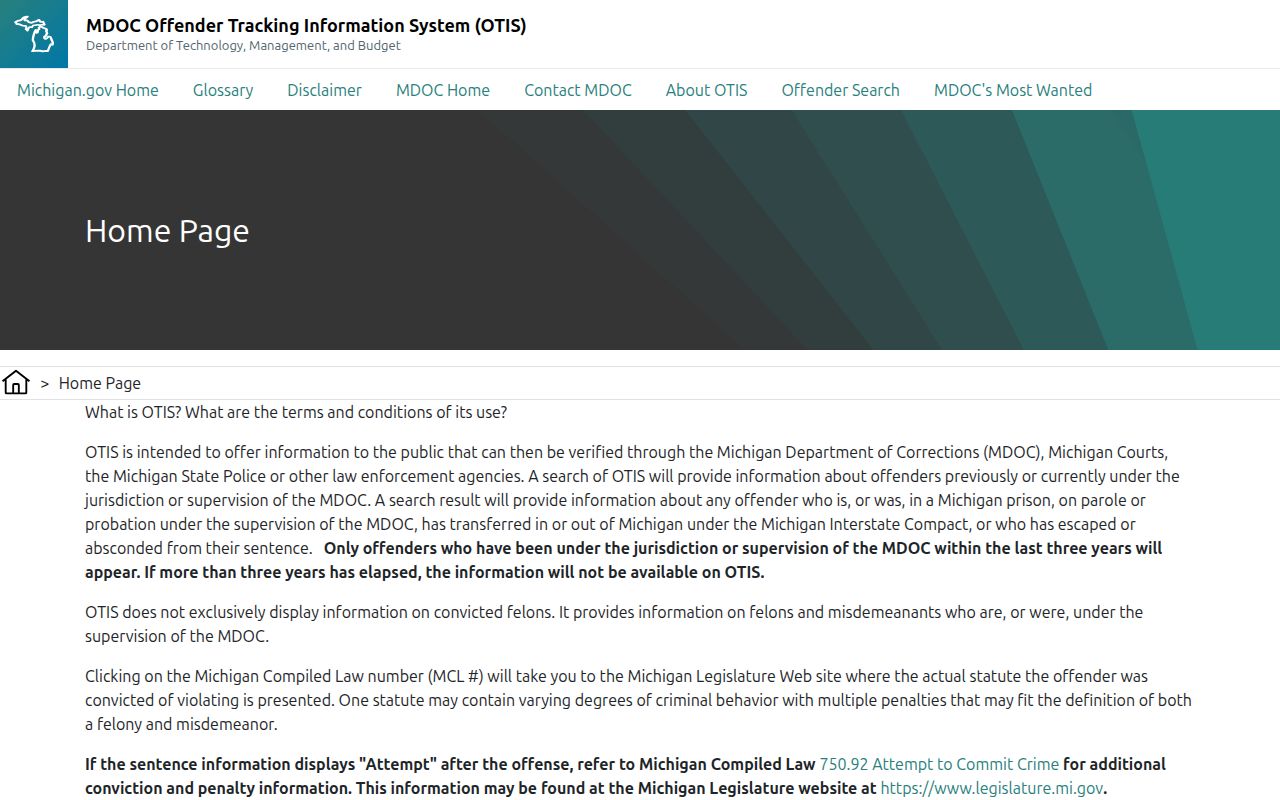
The interface belongs to MDOC and should never be presented as a current Roscommon County Jail roster.
Michigan Corrections Release Records
When the public profile lacks the needed detail, request a specific state record. Useful targets include a discharge certificate, parole action or date record, time computation, or releasable photograph. Provide the full name, birth date, MDOC number, sentencing court and case, and a narrow date range. MDOC does not have to create a record that does not exist and may redact material protected by law.
MDOC FOIA Coordinator
Email: MDOC-FOIA@michigan.gov
Mail: P.O. Box 30003, Lansing, MI 48909
Phone: 517-335-4194
Fax: 517-335-4193
Michigan FOIA generally calls for a response within five business days, with one extension of up to ten business days. That response date is not always the production date for a larger request. Fees follow MCL 15.234 and must be itemized. Asking for electronic delivery and a focused date range can reduce search and duplication work.
Current-prisoner record questions go to Corr_Records_Info@michigan.gov. Past-prisoner questions up to six years after release are routed to MDOC-Records_Retention@michigan.gov. Six years describes a contact route, not a destruction rule. For older material, ask whether the responsive record moved to another MDOC unit or the Archives of Michigan.
About Michigan Corrections in Roscommon
MDOC is a statewide system for people committed to state prison and for state parole and felony probation. Roscommon County's current JailTracker does not search this population. The physical location shown in OTIS can be outside the county, and Assigned Location after parole can point to a field office rather than a prison.
The MDOC Roscommon Parole/Probation office is listed at 500 Lake Street, Roscommon, MI 48653-0457, telephone 989-275-5422. The official directory publishes no general hours, public email, named unit, or walk-in rule. A person on supervision should follow direct agent instructions. The office is also distinct from the 82nd District Court Probation Department, which handles local misdemeanor probation.
Michigan Release Dates for Roscommon Prisoners
OTIS uses Earliest Release Date, not a profile field literally labeled “Projected Release Date.” The official OTIS field guide calls it the Parole Board Jurisdiction Date. Michigan generally uses an indeterminate sentence: the judge sets a minimum within the law, and statute supplies a maximum. The Board gains jurisdiction at the minimum, adjusted only by any lawful legacy credit regime.
Michigan is not a general 85 percent state. Truth-in-sentencing offenses require 100 percent of the judicial minimum in prison before parole consideration. Specified assaultive offenses committed on or after December 15, 1998, and other offenses committed on or after December 15, 2000, fall under that system. Good-time or disciplinary credits do not reduce that minimum.
Older offense dates require different analysis. Offenses after April 1, 1987 do not earn traditional good time. Eligible older cases may receive disciplinary and exemplary credits under MCL 800.33, subject to forfeiture and statutory limits. Court corrections, jail credit, consecutive sentences, misconduct, parole denial, placement, and a suspended grant can all change the public date.
Roscommon Parole Decisions and Physical Release
The Michigan Parole Board is the state's sole paroling authority for felony offenders committed to MDOC. Eligibility under MCL 791.234 does not create a right to release. MCL 791.233 requires reasonable assurance that release will not create a public-safety risk before the Board grants parole.
The official parole consideration process usually begins about six months before eligibility or reconsideration. Routine interviews are generally held by secure video, and most decisions are made by three-member panels. A grant goes to the Parole Release Unit for placement, conditions, and release coordination. At least 28 days normally separates the decision from physical departure, and new adverse information can suspend a grant.
The public hearing registration page covers limited Lifer Law, commutation, and pardon matters. It is not a calendar for routine interviews, and no authoritative searchable decisions database was found. Confirm release through Date Paroled and status, the person's notice, Board or MDOC records, or a focused FOIA request.
Discharged Michigan Corrections Records
A Discharged OTIS profile can show the discharge date and reason for the displayed state order. It does not necessarily resolve a separate county, federal, immigration, or out-of-state matter. OTIS also removes public profiles after its three-year post-discharge window, so an older absence is not proof that the person was never under MDOC authority.
Court-derived inaccuracies should be addressed to the sentencing court. Supervision location or absconder errors go to the assigned field office. Other OTIS accuracy concerns go to correctionsinfo@michigan.gov. Keep the MDOC number and the official order that supports the correction so the agency can identify the exact field in dispute.
Michigan Corrections Release Notifications
The official MI-VINE service offers general state-prison release notifications through VINELink and by telephone at 800-770-7657. Search the correct person, match the identifier, and register a phone, email, or text destination. A phone registration uses a four-digit PIN, which must be entered with the pound sign when a call arrives. An alert corroborates a reported event but does not replace the OTIS status or MDOC release record.
Direct victims seeking broader notice about parole eligibility, a hearing, decision, transfer, or discharge should also register with the MDOC Crime Victims Services Unit at 877-886-5401. That state route is distinct from county-jail participation in VINE. It also does not make the public parole-hearing page a calendar for routine cases.