
Roscommon Projected vs Actual Release
A projected, tentative, or eligibility date points to a future part of the sentence process. An actual release date records a custody change that has already occurred. Michigan OTIS does not label its prisoner profile field “Projected Release Date.” It shows an Earliest Release Date and a Maximum Discharge Date. The OTIS About page describes the earliest date as the Parole Board Jurisdiction Date, the first point when the Board may consider release.
Maximum Discharge Date is the endpoint when MDOC cannot continue imprisonment on the controlling sentence unless another authority applies. A prisoner may be paroled between the earliest and maximum dates. If parole does not occur, the maximum date governs the displayed sentence. Both fields can change when the underlying legal or administrative facts change.
A Roscommon County Jail detainee awaiting trial often has no fixed date at all. Bond, recognizance, dismissal, plea, sentencing, a hold from another agency, or a transfer may control the next event. A court order may authorize release before the jail finishes processing it, and leaving the local roster may reflect transfer rather than a return to the community.
That distinction also applies after sentencing. A maximum date concerns the sentence shown in the state system, but another valid sentence or detainer may take effect at the same time. A local release sheet can list a receiving agency when the person leaves Roscommon custody. Without that destination field, a roster disappearance or elapsed date remains incomplete evidence.
Find a Roscommon County Projected Release Date
Begin with custody type because OTIS excludes county jail and city lockup prisoners and people sentenced only to jail. A county case can still appear in the court system, while an MDOC sentence belongs in the state offender search. Federal and immigration cases require their own systems.
- Confirm whether the person is in Roscommon County Jail, MDOC, another county, federal custody, or immigration detention.
- For MDOC, open OTIS, accept its terms, and search by MDOC number or committed last name.
- Match the birth date, aliases, physical details, sentencing county, and court file before reading sentence dates.
- Read Current Status, Earliest Release Date, Maximum Discharge Date, Date Paroled, Assigned Location, and each sentence block together.
- For a county jail sentence, obtain the judgment, jail-credit entry, and local release computation from the court or jail record.
- Check for consecutive sentences, detainers, court corrections, parole decisions, and receiving agencies before treating any date as final.
- After departure, confirm the actual event through the jail release sheet or OTIS Date Paroled and status.
The official OTIS field definitions explain the scope and limitations attached to the state fields.
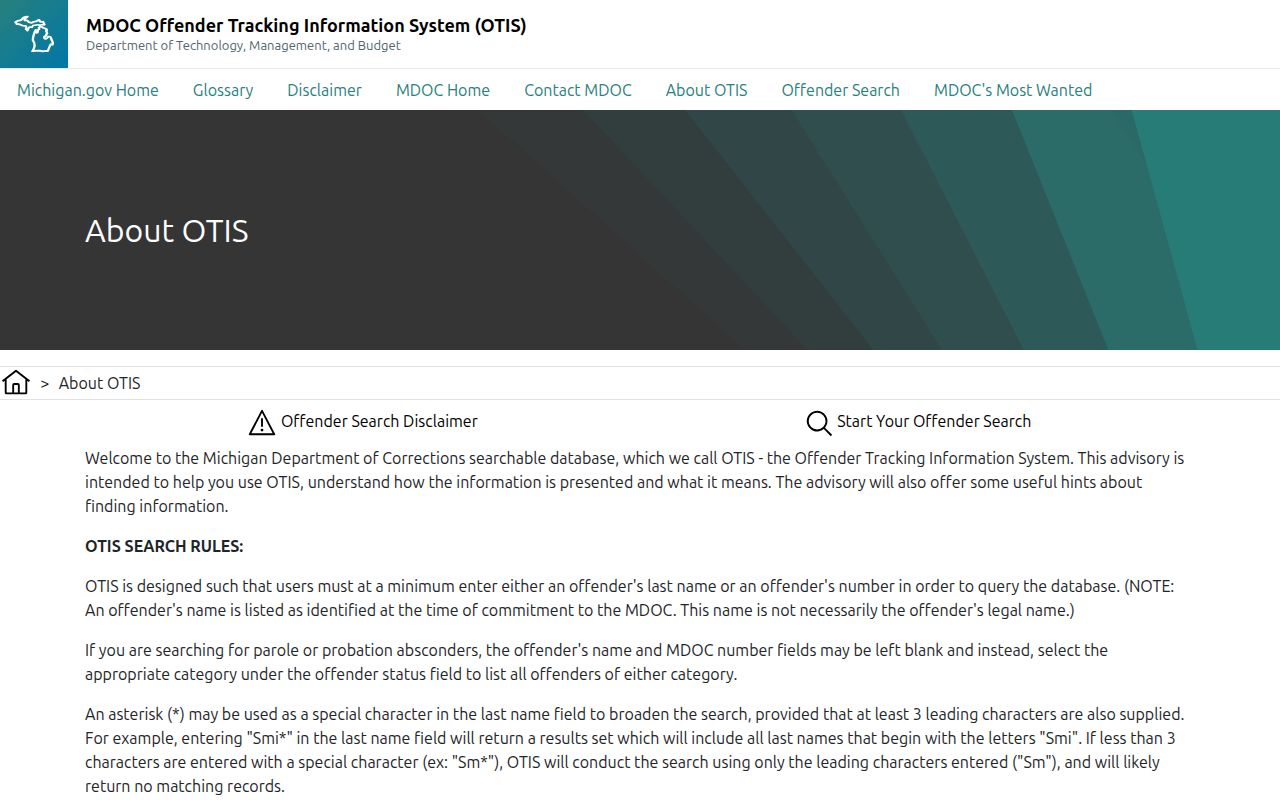
The field guide reinforces that the earliest date is tied to Board jurisdiction and should not be presented as a guaranteed Roscommon County release appointment.
OTIS uses the committed name. When a name search fails, check aliases and spelling, then use at least three leading surname letters before the supported wildcard. A common name requires more care. Compare the MDOC number, date of birth, physical identifiers, sentencing county, and court number. A profile for the wrong person can produce a plausible date that has no link to the Roscommon case being researched.
Michigan Sentence Rules for Roscommon Releases
Michigan generally uses indeterminate sentencing. The judge sets a minimum within the law, and the statute supplies a maximum. Start with the controlling sentence and the offense date, then identify whether truth in sentencing or an older credit regime applies. Court-awarded jail credit and the structure of concurrent or consecutive sentences also matter. MCL 769.8 supplies the minimum and maximum framework, while MCL 791.233 and MCL 791.234 govern the Board's release standard and jurisdiction.
Michigan is not a blanket “serve 85 percent” state. Under truth in sentencing, the person serves 100 percent of the judicial minimum in prison before parole consideration. The framework applies to specified assaultive offenses committed on or after December 15, 1998, and other offenses committed on or after December 15, 2000. Good-time or disciplinary credits do not shorten that truth-in-sentencing minimum. Class I disciplinary time may still be considered in the parole decision.
Offense date is critical in older cases. MDOC's glossary states that offenses after April 1, 1987 do not earn traditional good time. Eligible pre-truth-in-sentencing cases can receive disciplinary credits of five days per month plus as many as two exemplary days, subject to a cap of 84 days per year, misconduct forfeiture, and the controlling law. MCL 800.33 covers older good-time and disciplinary-credit rules. MCL 800.34 addresses disciplinary time in the truth-in-sentencing system.
The arithmetic is only one part of the answer. Earliest Release Date begins Board jurisdiction, and the Board still applies a discretionary public-safety standard. A grant then moves to release planning. Placement requirements and new adverse information can delay or suspend departure. For that reason, even a correctly computed eligibility boundary is not a promise that the person will leave on that day.
Note: Never apply today's credit rule to an older Michigan sentence without checking the offense date and controlling judgment.
Why Roscommon Release Dates Change
A date can move because the sentence record changes, the Board makes a discretionary decision, or another authority affects custody. The reason should come from the corrected judgment, OTIS, Board notice, jail calculation, or detainer record. Guessing from an earlier public date can blur a legal change with a simple update delay.
| Factor | Possible effect on the date | Record to check |
|---|---|---|
| Court correction or jail credit | Changes the time credited or the controlling judgment | Sentencing court order and jail computation |
| Multiple sentences | A consecutive term can extend the controlling endpoint | Sentence blocks and judgment |
| Legacy credits | Eligible credits may accrue, be withheld, or be forfeited | MDOC time computation under the offense-date law |
| Misconduct | May affect credits or parole consideration under the applicable regime | MDOC disciplinary and parole records |
| Parole denial | Release does not occur at the eligibility boundary | Board notice and later OTIS status |
| Suspended grant | New adverse information may stop departure before it occurs | Board and Parole Release Unit records |
| Placement or processing | A grant may await approved placement and required steps | MDOC confirmation |
| Detainer or another sentence | Release from one custodian may become transfer | Jail event record and receiving authority |
Confirm a Roscommon County Release Date
For county custody, the current JailTracker answers only whether a person appears in Roscommon County Jail at that moment. It provides no verified historical release archive. A missing current match can mean bond, sentence completion, dismissal, probation, medical movement, return to Oscoda, or transfer to another authority. Ask the jail for the existing booking and release record or proof of incarceration, then compare the result with the 82nd District or 34th Circuit Court docket.
For state custody, look for Date Paroled with a current Parole status. A Discharged status, date, and reason concerns the end of the displayed MDOC order. OTIS itself warns that status, location, and projected dates may not be current. A grant does not prove departure because the Parole Release Unit must coordinate placement and at least 28 days normally separates the decision from physical release.
After a parole departure, Assigned Location can identify the field office responsible for supervision. A later Supervision Discharge Date is a different milestone and should not be substituted for Date Paroled. The former concerns the end of supervision, while the latter marks release from prison onto parole. Recording both dates preserves the actual sequence.
A VINELink release check can add an event alert for participating systems. Read “Out of Custody” as departure from the reporting custodian, not freedom from all custody. For an exact Roscommon jail time and destination, the jail release sheet is stronger.
Roscommon County Jail Sentence Timing
OTIS is not the calculator for a jail-only sentence. The sentencing judgment, credited days, local release computation, and jail event record control. Research found no Roscommon-specific published jail good-time formula, weekend release rule, standard processing time, or holiday procedure. Applying the state-prison framework to the county jail would create a date that the local sources do not support.
All Roscommon criminal cases begin in the 82nd District Court. Misdemeanors stay there through sentence, while felonies pass through preliminary stages and proceed to the 34th Circuit Court as applicable. MiCOURT may show a bond order, dismissal, judgment, sentence, jail credit, probation event, or commitment to MDOC. Those entries explain legal authority, but the jail record supplies the physical departure time.
When asking the jail or court, give the full name, birth date or booking number, case number, and date range. Request the existing record that shows booking time, release time, release disposition, authority, and receiving agency or destination when recorded and releasable. That wording seeks records instead of asking staff to create a new calculation.
Roscommon Parole Eligibility Is Not Release
The Michigan Parole Board normally begins its process about six months before eligibility or reconsideration. Routine interviews are generally conducted by secure video, and most decisions are made by three-member panels. A denial can lead to annual review for high or average guideline scores and up to two years for low scores. The next review point is not an automatic release date.
The public hearing registration page covers limited Lifer Law, commutation, and pardon matters, not routine parole interviews. No authoritative public searchable decisions database was found. Use the prisoner's notice, later OTIS fields, Board or MDOC records, and a focused records request. A future date should always remain labeled as future and conditional until the agency records the custody change.
Correct a Roscommon Release Date Record
The correction route follows the source of the error. A judgment, sentence, or jail-credit error belongs with the sentencing court. A supervision-location or absconder issue belongs with the assigned parole or probation office. Other OTIS accuracy concerns may be sent to correctionsinfo@michigan.gov. Current-prisoner record questions go to Corr_Records_Info@michigan.gov, while past-prisoner questions up to six years after release are routed to MDOC-Records_Retention@michigan.gov.
The six-year routing period is not a destruction date. For older records, ask MDOC whether material was transferred or whether the Archives of Michigan holds it. Keep a copy of the challenged field, the matching identifier, and the court document or agency record that supports the correction.